
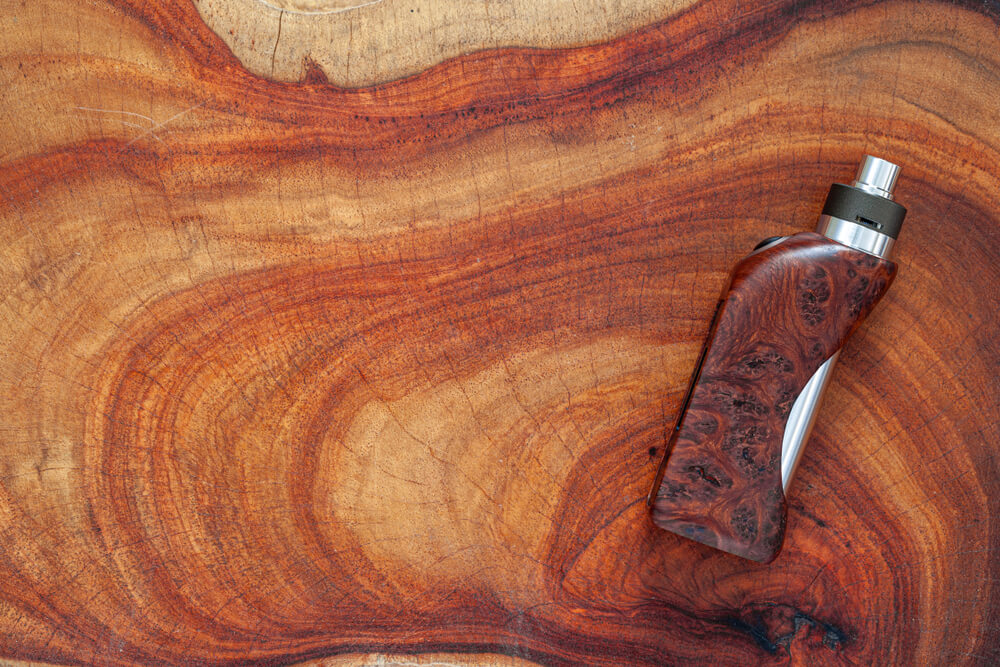
Whether you're scrolling through new drops online or browsing the counter at a local shop, spotting a box mod finished with natural hardwood or stabilized wood immediately grabs your eye. Newer vapers are drawn to the warm grip and distinctive color swirls, while seasoned builders appreciate the bench-work required to shape an organic material. Unlike mass-produced alloy frames that roll off the assembly line looking identical, timber brings an individual grain where no two devices share the same look. Yet blending raw timber with modern vape hardware creates an unusual collision between old-school woodworking and electronic design. Exploring how these organic materials actually find their way into everyday setups shows why they continue to earn such a dedicated following.
Inside the Modern Box Mod: Electronic Precision and Structural Armor
Before looking at how carvers shape timber for vaping gear, you've got to look at what a box mod is built to handle. Unlike a stripped-down pod or a fixed-output tube, a regulated box mod is a compact power plant engineered for absolute control over your puff. Tucked inside the shell is a sophisticated microprocessor board loaded with surface-mount capacitors, voltage regulators, safety sensors, and a display screen that tracks everything from coil resistance to puff counts. Whether drawing current from internal rechargeable cells or dual high-drain 18650 or 21700 batteries resting in a spring-loaded sled, that chipset controls wattage output with precision, providing custom heat curves and safety cutoffs.
To make all that electronic control useful, the device needs a rock-solid structural interface. On the top deck sits a threaded 510 connection plate, typically machined from stainless steel with a spring-loaded center pin, where you screw down your choice of sub-ohm tank, rebuildable dripping atomizer, or rebuildable tank atomizer filled with e-juice. When you press the fire switch, amps of current flow through internal wiring, across the board, and straight into your heating element. That means the outer casing isn't just an ergonomic handle; it's the protective vault holding delicate solder joints in place, shielding internal batteries from blunt drops, and maintaining a rigid platform so heavy atomizers don't snap the connection deck under everyday stress.
The Biology of Wood: Cellular Architecture and Natural Volatility
In its natural state, wood is a porous, fibrous structural tissue found in the stems and roots of trees and woody plants. Mechanically, it operates as a natural composite: long, crystalline cellulose fibers that provide high tensile strength are bound within an amorphous matrix of lignin, which gives the plant wall its compressive stiffness and rigidity. As a tree grows through changing seasons, variations in cellular division produce distinct growth rings, mineral deposits, and interlocking grain patterns. In specific growth conditions, trees can develop burls—swirling, irregular knots caused by stress, injury, or fungal growth—which display chaotic, prized figure patterns completely distinct from straight-grained timber.
Because wood is an organic cellular structure, it remains inherently hygroscopic throughout its entire physical life. The cellulose walls constantly absorb and release ambient water vapor to stay in equilibrium with surrounding air humidity. When humidity rises, the cell walls swell and the wood expands across its grain; when air dries out, the fibers contract, creating internal stress that often results in warping, bowing, or spontaneous surface checks and cracks. Wood is also a natural thermal and electrical insulator, with virtually zero free electrons to conduct electrical currents. Left untreated, raw timber is vulnerable to moisture rot, surface scratching, and open combustion when subjected to concentrated heat sources.
Crafting the Organic Chassis: Hardwoods, Resin Infusion, and Internal Architecture
Bringing an organic material into the world of electronic vaping demands serious craftsmanship. Wood doesn't behave like molten zinc poured into a steel die, nor can it be carved with high-speed automated tooling without careful consideration of grain orientation. Device builders have spent years perfecting techniques that highlight the natural beauty of timber while taming its physical vulnerabilities.
Exotic Hardwoods and the Science of Stabilized Burls
High-end, custom-made box mods generally rely on two distinct approaches to lumber: dense natural hardwoods or vacuum-stabilized burl blocks.
When builders work with raw timber, they gravitate toward dense, oily hardwoods like African blackwood, walnut, rosewood, and ebony. These species naturally resist minor moisture changes better than softer woods, and craftsmen spend hours hand-sanding the blocks before sealing them with hand-rubbed mineral oils or carnauba waxes. The result is a warm, velvety touch that develops a rich, personal patina over years of handling.
However, natural burls—the most visually stunning cuts of wood—are notoriously unstable, full of microscopic air pockets, soft voids, and fragile grain twists. To make this delicate timber tough enough for daily hardware duty, artisans turn to a process known as stabilization.
First, the burl block is kiln-dried until internal moisture drops to virtually zero percent. The wood is then submerged in liquid acrylic or polymer resin inside a deep vacuum chamber. As the vacuum pump pulls air out of the tank, it purges all the trapped gases and moisture from every microscopic cell cavity inside the wood.
Once the air is entirely removed, the chamber is brought back to high atmospheric pressure, which forces the liquid resin—often infused with brilliant colored dyes—deep into the wood's hollow cellular structure.
Finally, the soaked block is baked in a curing oven, where heat activates chemical catalysts that polymerize the liquid resin into a solid, rock-hard plastic throughout the timber's vascular frame.
This transformation produces "stabilized wood" (or "stabwood"). It retains the wild, organic swirl of the burl grain, but gains the density, scratch resistance, and moisture immunity of acrylic. It won't swell on humid summer afternoons, won't dry out in winter, and can be buffed to a mirror shine just like high-grade resin.
Why Wood-Only Box Mods Don't Exist
While a custom device might look like a single, seamless block of timber from the outside, it's mechanically impossible for a functioning box mod to be made exclusively of wood.
The most obvious roadblock is electrical conductivity. Wood is an electrical insulator; it has no free electrons to complete an electrical circuit. In regulated vape hardware, current must move reliably from the negative battery terminal back to the chipset through a dedicated return path. You can't solder electronic components to an oak board, nor can timber carry the heavy electrical current required to fire sub-ohm coils safely.
Furthermore, wood is an organic combustible material. Clamping high-drain lithium-ion cells directly against raw lumber, or mounting a red-hot atomizer deck straight onto a wooden plank, presents an obvious thermal hazard if an internal connection ever overheats.
Mechanical strength at micro-tolerances creates another hurdle. Wood fibers simply can't hold the tiny machine threads needed to secure battery access doors, faceplates, or 510 threaded rings; repeated battery swaps would strip those soft threads within weeks.
Because of these realities, every wood box mod is actually an engineered hybrid. Inside that beautifully carved exterior sits an internal skeleton—a sub-chassis machined from aircraft-grade aluminum, brass, Delrin, or heat-resistant PEEK plastic.
This hidden frame does all the heavy mechanical and electrical lifting: it provides insulated bays for your batteries, anchors the threaded stainless steel 510 plate, houses the wiring, and provides solid screw points for circuit boards.
The carved timber functions as an exterior armor, body sleeve, or set of sculpted magnetic panels. It provides the hand feel, shock absorption, and visual identity, while the internal framework makes certain the device operates with modern safety and reliability.
Practical Factors to Weigh Before Choosing a Wood Mod
Bringing a timber device into your rotation adds unmistakable personality to your vaping sessions, but living with an organic material calls for a different mindset than carrying stamped metal. Whether you're eyeing a boutique stabilized piece as your first premium upgrade or you're an experienced collector evaluating a custom handmade block, knowing how these casings behave over time will save you headaches down the road. Before you pick out a specific grain or resin swirl, keep these practical realities in mind:
- Surface Conditioning and Daily Maintenance: Natural hardwoods like walnut or ebony require regular upkeep with mineral oil or beeswax to prevent the timber from drying out and dulling. If you're a newer vaper who wants a lower-maintenance setup, stabilized wood makes life easier because the cured resin seals the cellular pores; all it takes is an occasional pass with a dry microfiber cloth or a touch of fine polishing compound to bring back its showroom luster.
- Thermal Insulation and Hand Comfort: Metals rapidly pull warmth away from your atomizer, spreading heat across the frame until your fingers feel the burn during heavy chain vaping. Wood works as a natural thermal barrier, meaning the outer grip stays comfortable in your palm during intense sessions and feels warm to the touch on freezing winter mornings. Experienced builders should note, however, that because the wooden body doesn't act as a heatsink, heat stays concentrated around the internal metal sub-chassis and 510 deck, meaning heavy, power-hungry tanks take slightly longer to cool off between draws.
- Sunlight and Temperature Exposure: Leaving any vape hardware on a hot car dashboard is dangerous for battery cells, but it's especially brutal on natural and stabilized woods. Prolonged exposure to intense ultraviolet sunlight will bleach the rich dyes in stabilized resin and dry out natural oils in raw timber, leading to faded colors or hairline surface checks. Keeping your mod out of direct window light and storing it in a temperature-controlled space preserves the vivid contrast of the burl figure for years to come.
- Grip Bulk or Stable Stability: Because carvers need sufficient wall thickness to make sure the timber doesn't crack around internal cutouts, wood mods are naturally chunkier than ultra-slim aluminum shells. That extra thickness lets craftsmen shape generous, flowing palm swells that feel incredible in the hand, but it also creates a wider footprint. For vapers who run heavy rebuildable tanks at home, that broader, flatter base creates a solid platform that prevents accidental tip-overs, though it might take up a bit more room in a travel bag or vehicle console.
Bringing Genuine Craftsmanship to Every Puff
Choosing a box mod wrapped in natural timber or stabilized burl changes your relationship with your vaping hardware from the very first click. It replaces the sterile uniformity of industrial alloy with an organic warmth and visual depth that simply can't be stamped out by a factory machine. As long as you respect the care it requires and appreciate the internal engineering that keeps those circuits protected, a finely carved mod delivers a personal touch you'll never tire of holding. Every swirl of grain tells its own quiet story, reminding you that great performance doesn't have to come at the expense of authentic character.