
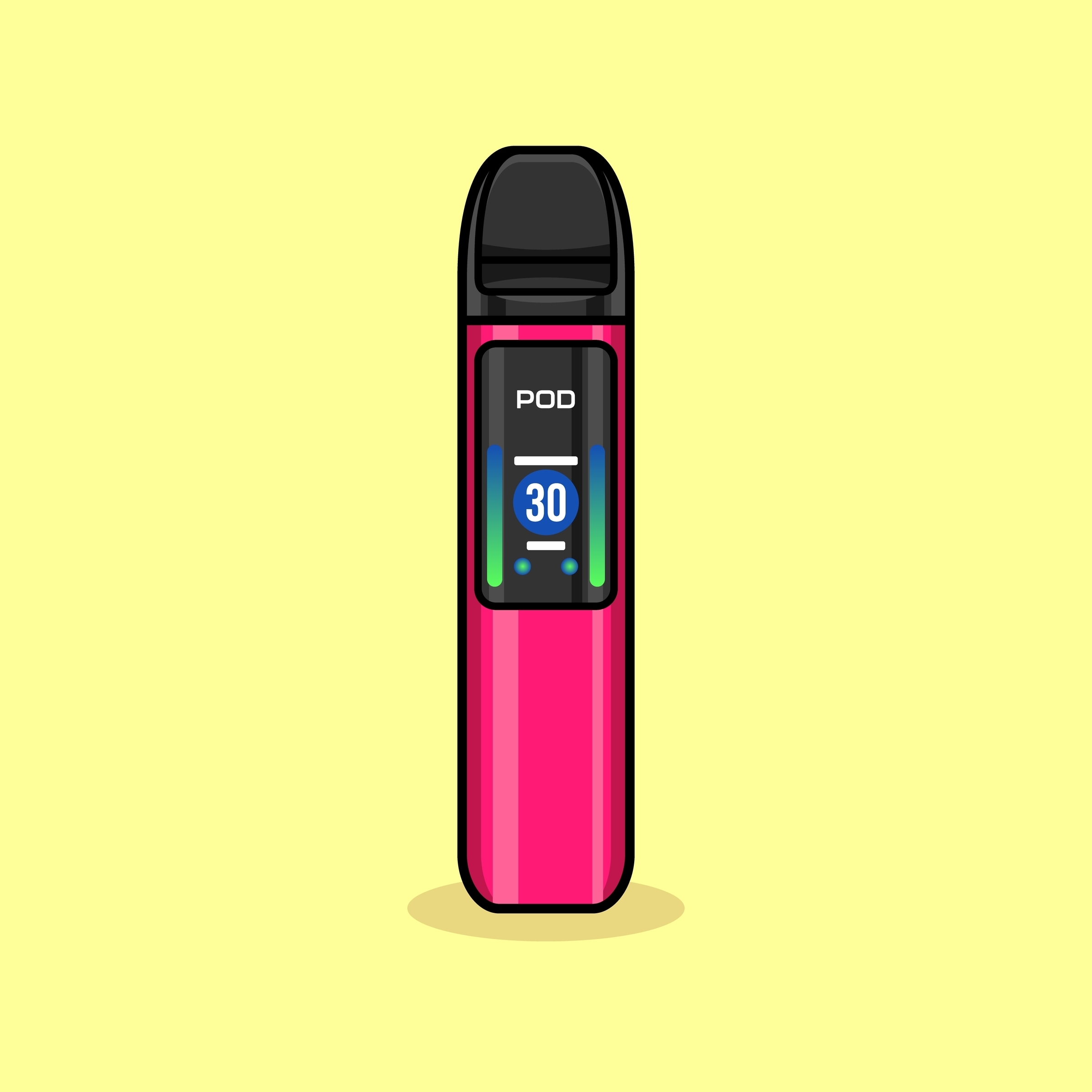
You just filled a brand-new refillable pod cartridge with fresh vape juice, clicked it into your pocket-sized setup, and took that first pull only to get a surprisingly muted taste. It's second nature to grab the device and start clicking the power button, hopping power levels to coax some immediate punch out of the coil. Shifting firing profiles before that tiny cotton wick establishes an even flow throws sudden heat into dry fibers. Microchips switch their output in the blink of an eye, but compact pod cartridges still obey the physical reality of wicking speed. Rushing your settings before the cartridge finds its natural rhythm burns through delicate flavorings and ruins a fresh pod before it ever hits its stride.
The Design and Anatomy of an Open Pod System
To grasp why power adjustments disrupt your vape juice so fast, you have to look at how an open pod system is put together. An open pod system isn't a sealed, throwaway convenience device, nor is it a heavy-duty setup with a bulky tank. It's a lightweight, streamlined unit engineered specifically for portability, discretion, and day-to-day simplicity. The entire device centers around two main pieces: a slim battery housing and a refillable, detachable pod cartridge.
The housing holds a compact, rechargeable lithium-ion cell, usually running between 500mAh and 1200mAh. While that capacity sounds modest compared to large tabletop gear, it's matched to deliver steady power through an internal circuit board tuned for energy efficiency.
Mounted at the top of that battery casing is an open receptor bay. Rather than using threaded metal joints, this bay holds the pod cartridge in place using small neodymium magnets, mechanical snap-fit retention clips, or a friction-fit track.
Inside that recessed dock sit spring-loaded, gold-plated electrical contacts that meet the bottom plates of the cartridge. Tucked right between those contact pins, you'll frequently find the rubber-gasketed intake of a pneumatic draw sensor. This miniature microphone-style diaphragm measures pressure drops when you inhale, completing the circuit automatically without requiring a physical button press. Many modern units pair that sensor with a tactile manual firing button, letting vapers choose between automatic puffing and instant button activation.
The top piece of the puzzle is the refillable pod cartridge itself. Molded from food-grade PCTG plastic, this reservoir generally holds between 2ml and 3ml of e-liquid.
Refilling happens through an offset port sealed by a tight silicone rubber stopper.
Inside this small plastic housing sits a miniature chimney containing the heating element. Depending on the model, that element is either permanently built into the cartridge or takes the form of a tiny, replaceable coil slid into the base.
Because open pod systems are built for controlled, cigarette-like draws or restricted direct pulls, these coils sit at standard resistance levels, typically between 0.6 ohms and 1.4 ohms. The heating wire, usually formed from fine Kanthal or a miniature stainless steel mesh screen, is wrapped in a compact, dense layer of organic cotton.
Because space is limited inside a 2ml pod, that cotton barrier is remarkably thin. The juice intake ports feeding that cotton are small holes cut into the chimney base.
Airflow travels through miniature intake slots along the side of the battery chassis, passing underneath the pod base, traveling through the center of the coil wire, and moving directly up the integrated whistle-style mouthpiece.
Because the plastic pod forms a sealed, airtight chamber once closed, liquid doesn't flood through the tiny coil ports thanks to surface tension and internal negative pressure.
Every time you take a draw, that delicate pressure shifts slightly, pulling a small portion of e-liquid into the cotton to replace what just vaporized. When you jump across power settings prematurely, you throw off this miniature ecosystem, altering internal pressure and heat transfer in a confined space.
The Open Pod Firing Suite: Operating Modes and Power Adjustments
Open pod systems keep interfaces simple, but modern microprocessors still offer plenty of ways to change how power hits the coil:
- Stepped Voltage / Power Tiers (Low, Medium, High): The most common adjustment method found on button-equipped open pods. Rather than displaying precise numeric digits, the device relies on a single multi-color LED or a row of indicator lights to signal distinct power bands. Triple-clicking the button cycles through predefined outputs: Low (often signaled by a red light, around 3.0 to 3.2 volts), Medium (a blue light, around 3.4 to 3.5 volts), and High (a green light, delivering 3.7 to 3.8 volts). This stepped control lets vapers increase vapor warmth and throat hit without needing a complicated interface.
- Variable Wattage (On Screen-Equipped Pod Units): Found on advanced open pod devices carrying miniature OLED or digital displays. This mode lets you dial in numeric power in single-watt or half-watt steps, typically spanning 5 watts to 25 or 30 watts. The board reads the cold resistance of the pod cartridge through the dock contacts, calculating the required voltage to maintain that exact wattage setting across the length of your puff.
- Smart Coil-Matching Mode: A protective automated profile programmed into the chipset. When you snap a fresh pod cartridge into the housing, the board reads the coil's baseline resistance and automatically sets the wattage to the middle of the factory-recommended power bracket. If you insert a 1.2-ohm cartridge built for gentle draws, Smart Mode sets the device to 10 or 11 watts and restricts you from accidentally pushing the power up to 25 watts, saving the coil from instantaneous failure.
- Bypass / Direct Output Mode: Strips away voltage regulation and feeds the raw current of the lithium cell straight into the pod's base contacts. In this mode, output isn't constant; it depends entirely on the cell's charge state. A fully charged battery delivers 4.2 volts, creating a hot, punchy hit that gradually softens as the cell drains toward its 3.3-volt safety cutoff.
- Boost / Turbo Modes: An aggressive firing curve that dumps a quick spike of electrical power into the coil the moment the draw begins. Designed to eliminate ramp-up lag on miniature mesh coils, Boost Mode delivers 10% to 15% extra voltage for the first two-tenths of a second before dropping down to the selected baseline. This creates immediate vapor without waiting for the fine wire to warm up naturally.
- Eco / Power-Saver Mode: A battery-conservation profile that activates manually or kicks in on its own when the cell drops below a specific voltage threshold, usually around 20% remaining capacity. The microprocessor pulls back peak output, softens the ramp-up time, and dims indicator lights to preserve battery life, which alters the vaporizing temperature at the coil.
- Pneumatic Auto-Draw vs. Manual Button Curves: Many open pods alter their power delivery based on how you fire them. Taking a draw through the pneumatic air sensor often triggers a softer, gradual ramp-up curve linked to your inhale strength. Pressing the tactile fire button bypasses that sensor ramp-up entirely, instantly hitting the coil with full set power the millisecond the switch clicks down.
E-Liquid Chemistry in Compact Pod Environments
To see why sudden setting shifts can damage your vape juice, you must look at how e-liquid behaves in tight quarters. E-liquid isn't just scented liquid; it's a solution of chemical carriers, active nicotine compounds, and complex aromatic flavoring molecules. Every ingredient reacts to temperature changes in a specific way, and those reactions become much more pronounced inside a tiny 2ml pod cartridge.
Nicotine Salts vs. Freebase Nicotine in Small Pods
The nicotine profile in your bottle governs how your pod cartridge reacts to thermal changes. Freebase nicotine is the traditional, chemically unbonded form of nicotine. It carries a relatively high, alkaline pH level around 8.0. That alkalinity produces a strong, sharp throat hit when vaporized at high concentrations. In open pod systems, vapers who prefer freebase liquid usually choose 6mg or 12mg strengths paired with lower-resistance pods (like 0.6 or 0.8 ohms) to get a balanced, comfortable throat hit.
Nicotine salt e-liquid takes a different approach. Formulators take freebase nicotine and mix it with an organic acid—most often benzoic acid, though levulinic or salicylic acids are also used. This acid treatment lowers the solution's pH to a neutral 5.5 to 6.5.
By neutralizing the natural alkalinity, the harshness on the throat vanishes. This chemical shift lets vapers comfortably consume high strengths, like 25mg, 35mg, or 50mg, without irritation.
These potent salt formulas are mixed specifically for low-power open pod systems running higher-resistance coils (0.8 ohms to 1.4 ohms) that produce small, concentrated amounts of vapor.
The catch is that nicotine salt molecules are chemically sensitive to rapid thermal swings. The bond between the nicotine and the organic acid is relatively delicate.
If you take a fresh pod cartridge loaded with 35mg or 50mg nicotine salt and jump from a gentle Low power setting straight into High or hit it with Boost Mode before the wick is saturated, you shock those chemical bonds.
The heat shears the organic acid bond apart, causing the nicotine salt to de-protonate back into freebase nicotine while flashing a concentrated dose of vapor into your throat.
The smooth inhale you expected vanishes instantly, replaced by a harsh, peppery scrape that burns your throat and leaves a stale, bitter aftertaste.
Viscosity Dynamics and Capillary Pressure
The base of your e-juice balances vegetable glycerin (VG) and propylene glycol (PG). Vegetable glycerin is a thick, syrupy plant derivative with an exceptionally high boiling point of roughly 290°C. Because of its dense molecular structure, VG moves slowly through cotton at room temperature, requiring gentle heat to thin out and travel through microscopic fibers.
Propylene glycol is a much thinner liquid with a lower boiling point around 188°C. It carries flavorings efficiently, thins the overall recipe, and soaks through cotton fibers almost instantly.
Most nicotine salt vape juice uses a balanced 50/50 VG/PG ratio. This thin consistency is vital for open pod systems because the juice intake holes on miniature pod cartridges are remarkably small. A 50/50 mix wicks smoothly through these tiny ports, maintaining steady capillary action even during frequent pulls.
Freebase liquids, on the other hand, frequently run at 70/30 VG/PG, which is much thicker.
In an open pod cartridge, radiant heat from the coil warms the small chimney casing, transferring warmth into the 2ml reservoir. This gentle warming thins the surrounding e-liquid, helping it flow freely into the wick.
If you jump to a high power setting before this wicking balance establishes itself, the coil vaporizes the thin, low-boiling PG immediately. If the thicker VG hasn't had time to thin and move inward, the cotton directly touching the wire runs dry in a fraction of a second, causing dry spots right in the center of the coil while the pod appears completely full.
Fragile Flavor Esters and Sweetener Pyrolysis
The flavor inside your e-juice is created by combining aromatic chemical compounds like esters, aldehydes, and terpenes. These volatile aroma compounds have precise boiling ranges.
Bright top notes like sweet blueberry, green apple, tart citrus, and fresh mint rely on delicate esters that vaporize cleanly at low temperatures between 140°C and 170°C. Richer base notes like vanilla, custards, and caramel require temperatures between 190°C and 210°C to release their depth.
When you flip power settings too quickly, you disrupt this delicate balance. Sudden spikes in heat shatter fragile fruit esters, decomposing them into harsh chemical compounds that taste like burnt rubber or acetone.
Modern vape juice also relies heavily on artificial sweeteners, primarily sucralose. Sucralose begins to break down around 120°C and rapidly pyrolyzes at 200°C.
In a stable setup, the continuous pull of e-juice across the coil washes atomized sweetener into the vapor stream.
When you spike the power before the cotton is saturated, unvaporized sucralose burns directly onto the wire. It sheds its volatile components and leaves behind a layer of black carbon crust.
Because open pod coils are tiny, even a microscopic speck of carbon crust ruins the coil. The crust acts as a heat shield, preventing fresh vape juice from touching the wire cleanly. The e-liquid then pools against that hot carbon shell, stewing and turning bitter, muddying the flavor of every puff that follows.
The Core Impact: What Switching Modes Too Soon Does to Your E-Liquid
Now let's tackle the central question: does adjusting or switching an open pod system's modes too soon positively or negatively impact an e-liquid? With few exceptions, jumping across power modes before your cartridge establishes a steady physical rhythm triggers a chain reaction that damages the coil, breaks down the e-juice chemistry, and ruins your vaping experience.
Capillary Starvation and Instant Cotton Singeing
The primary danger of switching power modes prematurely is capillary starvation. Because open pod cartridges are built small, the internal coil uses a surprisingly thin wrap of compressed organic cotton. When you install a fresh cartridge and fill it with e-liquid, the liquid absorbs into the outside layer of the cotton quickly, but it takes time to seep through the compressed fibers to the wire surface.
If you take a couple of short puffs on a Low setting and immediately double-click or triple-click your way to High, or jump from 9 watts straight to 18 watts, your heat ramp-up outpaces liquid delivery.
The tiny layer of e-liquid sitting against the wire vaporizes in milliseconds. Because the inner fibers haven't established steady capillary flow, fresh vape juice can't move through the tight intake ports fast enough to replace what boiled away.
The bare metal wire glows directly against dry cotton. Even a half-second dry hit scorches those delicate plant fibers, creating permanent carbonization.
Once cotton fibers burn, they lose their capillary draw for good. That singed core leaches an acrid, burnt taste into every subsequent drop of e-juice that passes through it, turning a brand-new cartridge into trash within its first ten minutes of use.
Cartridge Reflux and Reservoir Discoloration
Premature mode switching doesn't just damage the cotton; it pollutes the unvaped e-liquid sitting inside the 2ml reservoir through a process called cartridge reflux.
When a miniature coil overheats from an unexpected surge in power, the e-liquid sitting in the wick doesn't always escape as vapor. A large portion of it partially cooks, flashing off light PG and volatile flavors while concentrating heavy VG, food colorings, and sweeteners into a thick, dark, half-burned syrup.
When you release the button or stop puffing, the coil and the chimney cool down immediately. As the metal and hot air contract, they create a momentary vacuum inside the wicking chamber.
That vacuum draws that scorched, caramelized syrup backward through the wick ports and straight into your clear pod cartridge. Because an open pod reservoir is small—often just 2ml—it doesn't take much to spoil the entire batch. You can watch this happen as dark, amber streaks seep out of the wick ports and swirl into the transparent liquid. Within an hour, a crystal-clear mint or mango e-liquid turns into a cloudy, amber fluid with a stale, harsh taste. You aren't just dealing with a burnt wick anymore; you've contaminated the entire reservoir of vape juice.
The Bypass Mode Hazard on High-Resistance Pods
Flipping an open pod system into Bypass Mode is an easy way to ruin high-resistance cartridges, especially when your device sits on a full charge.
Regulated modes keep power locked within safe parameters. If you run a 1.2-ohm cartridge on a Medium stepped setting, the board sends roughly 3.4 volts to the contact pins, producing about 9.6 watts of comfortable, cool vapor that matches the wicking speed of the small coil.
If you switch the device into Bypass Mode with a freshly charged battery, the board stops regulating that output. It pushes the battery's full 4.2 volts straight into the cartridge.
Using Ohm's law (), we can calculate the result: , divided by .
That is an immediate 53% surge in thermal output on a delicate, tight-draw coil. The tiny wick channels simply cannot pull e-liquid fast enough to keep up with that sudden increase in heat flux. The internal cotton scorches on the very first puff, the sweetener turns to carbon crust, and your high-strength nicotine salt e-liquid becomes unvapeable.
Seal Distortion, Chamber Flooding, and Sensor Drowning
Open pod cartridges rely on a delicate vacuum balance to keep vape juice inside the pod and out of your battery compartment. The small plastic housing relies on internal air pockets to hold the e-liquid in place against gravity.
When you switch into aggressive power settings prematurely, the intense heat spike radiates outward through the chimney into the PCTG plastic base. That localized heat causes the bottom silicone seals to soften. At the same time, the excess heat warms the surrounding e-liquid, lowering its surface tension to near zero.
Without surface tension and vacuum pressure to hold it back, the thinned vape juice pushes straight through the cotton barrier and floods the internal airflow path.
The e-liquid drips through the bottom air holes of the cartridge and pools directly inside the battery bay.
This pooling liquid coats the spring-loaded gold contact pins and seeps straight into the rubber gasket protecting the pneumatic draw sensor. Once vape juice coats that delicate sensor diaphragm, the device begins to malfunction—throwing phantom auto-fire errors, failing to detect when you take a puff, or shorting out the circuit board entirely. What started as an impatient mode switch turns into a ruined cartridge and dead hardware.
Question: Can Mode Switching Ever Positively Impact Your E-Liquid?
While jumping power modes prematurely usually leads to burnt cotton and ruined flavor, there are specific, practical situations where a deliberate mode change can save your e-liquid. The trick is knowing what's happening inside the pod cartridge and using a gentle setting to solve a clear physical problem.
The most common situation is rescuing an oversaturated or flooded coil. If your open pod has been sitting in a warm pocket or left in a car, the e-juice inside thins out, pushes past the cotton barrier, and pools in the central chimney. When you try to take a puff on your standard setting, the coil can't cleanly vaporize that excess pool of liquid. It gurgles, spits hot droplets into your mouth, and blocks airflow.
You can fix this by temporarily dropping your power mode to the lowest setting (like Low or the Red LED tier).
By applying a gentle, lower voltage, you warm the coil slowly without shocking the wick. This boils off the pooled excess e-juice smoothly without explosive popping, clearing the flooded chimney. Once the airflow clears and the gurgle vanishes, you can return to your regular setting without having lost your vape juice or ruined your cartridge.
Another helpful application involves using a Low setting to break in thick e-liquids in cold weather. If you're vaping in a cold environment, vegetable glycerin thickens dramatically, turning syrupy and refusing to flow through small wicking ports.
Starting on a high power setting will instantly scorch the dry cotton. By taking three or four short puffs on the lowest power tier, the mild warmth from the coil gently radiates through the chimney, thinning the cold e-juice in the reservoir. Once the liquid thins and establishes a steady capillary siphon into the cotton, you can safely step up to Medium or High without scorching your wick.
Counter-Side Rules for Dialing in an Open Pod System
Adjusting your open pod shouldn't be an impatient guessing game. If you want to explore the different power tiers on your setup without ruining cartridges or wasting premium vape juice, follow these straightforward shop practices:
- Respect the Resting Period: Never fill a fresh, dry pod cartridge and start vaping immediately. Fill the reservoir, seal the silicone stopper firmly, and let the cartridge sit on your table for a solid ten to fifteen minutes. This rest period gives the compressed organic cotton the time it needs to absorb e-juice completely, clearing out air pockets and establishing a strong capillary siphon before any heat hits the wire.
- Always Start on the Lowest Tier: Regardless of which mode you plan on using for your daily vape, always fire a fresh cartridge on the lowest power setting (such as Low, the Red LED tier, or minimum wattage). Take ten to fifteen gentle, spaced-out puffs on this mild setting. This slowly tempers the wire, washes away residual manufacturing taste, and breaks in the cotton fibers without thermal shock.
- Step Up Power Gradually: When moving from Low to High, never skip steps. Transition from Low to Medium, take several draws over the course of a few minutes, and verify that the flavor tastes clean and saturated. Only move to High or engage Boost settings once you know the wick is keeping up with your draw pace.
- Space Out Your Puffs During Setting Changes: When testing a higher power tier, give your cartridge fifteen to twenty seconds between puffs. Because open pod wicks are compact, rapid chain-vaping on high settings can drain the cotton faster than the small intake ports can refill it. Spacing out your draws lets capillary pressure re-saturate the center of the coil between hits.
- Check the Pod Bay for Condensation: Every time you switch modes, pull the cartridge out of the dock and inspect the contact pins. Rapid temperature shifts create condensation around the base of the pod. Wiping the contacts and the draw sensor gasket dry with a clean paper towel prevents poor electrical connections and stops liquid from seeping into internal electronics.
Pacing Over Power
Clicking buttons makes it easy to forget that tiny cotton wicks need steady physical time to drink up fresh e-juice. Microprocessors can switch power delivery in the blink of an eye, but compact pod cartridges still run on natural capillary limits that no software setting can override. Rushing into high-output modes before the coil finds its thermal stride scorches delicate flavorings, breaks down nicotine salts, and turns clear vape juice into bitter sludge. Giving a fresh cartridge those few patient minutes to settle protects the liquid's balance and delivers the rich, smooth flavor you expected from the first pull to the last.